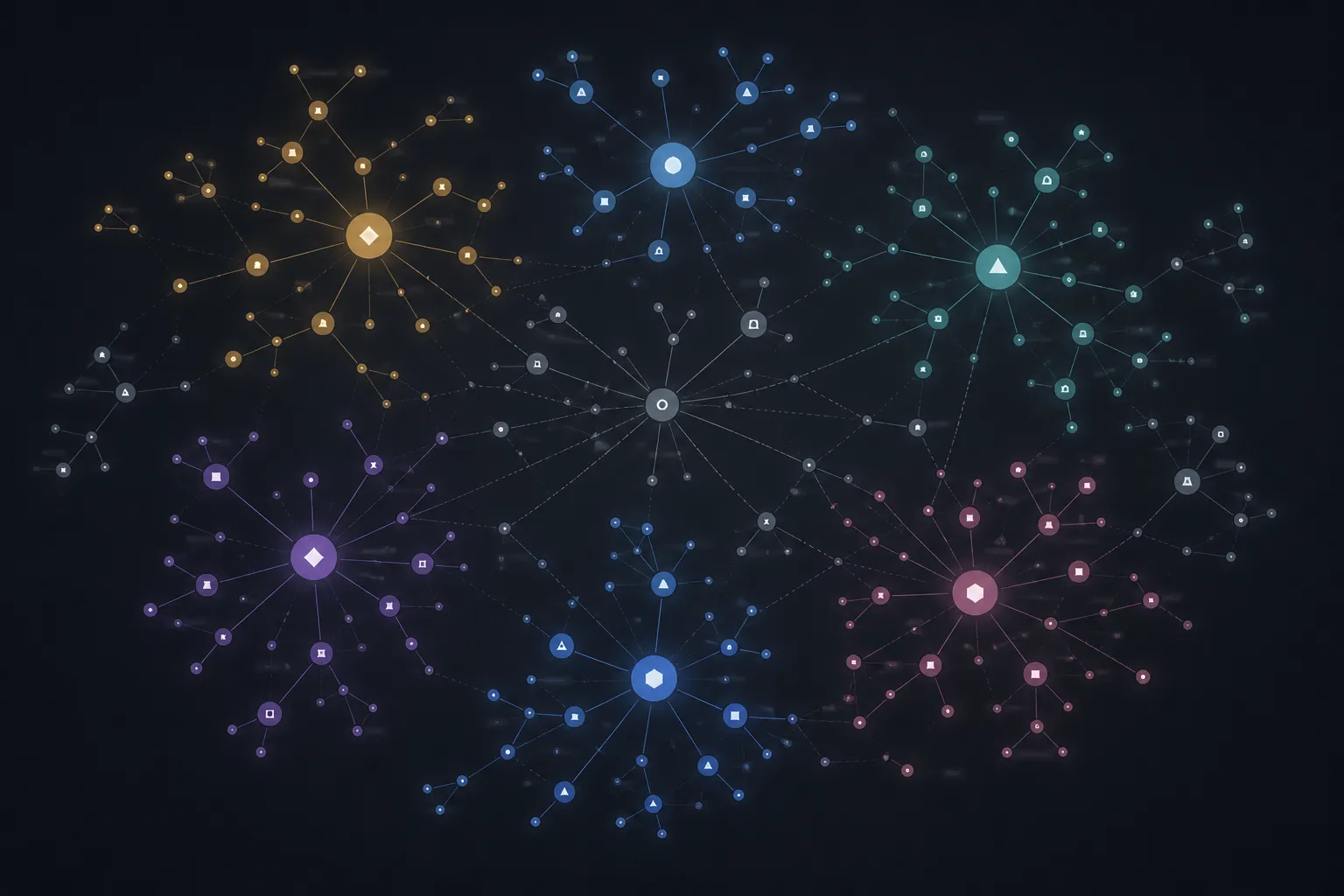
I use Obsidian as a second brain: a place to capture what happened, connect it to active projects, and preserve decisions that future me should not have to rediscover. The value is not having a large collection of notes. It is having reliable context when I need to make the next decision.
AI agents make that context more useful. Tools such as Claude and Codex can help inspect a project, compare the current state with an intended outcome, update documentation, automate a repetitive workflow, and verify the result. A well-maintained second brain gives those agents the background that normally has to be explained again in every session.
That convenience also creates a boundary I care about: I keep separate second brains for personal and work information.
A small operating system for knowledge
My personal vault follows a simple loop:
- Capture an idea, event, or open question in an inbox or daily note.
- Clarify why it matters and what action it implies.
- Connect it to a project, area, resource, or person.
- Review it often enough that the system stays current.
I organize the durable material using PARA:
- Projects contain outcomes I am actively trying to finish.
- Areas contain responsibilities I continue to maintain.
- Resources contain knowledge I expect to reuse.
- Archive keeps inactive material available without crowding current work.
A few map notes provide navigation across those folders. This is deliberately lightweight. The system should make work easier, not become another project to maintain.
Giving AI agents useful context
Without persistent context, an AI agent starts each task with partial information. It may understand the code in front of it but not why an earlier decision was made, which tradeoffs were rejected, or what “done” means for the project.
Project notes can close that gap. Before working on a personal repository, an agent can use a bounded set of material:
- the project goal and current status;
- architecture decisions and constraints;
- exact setup or validation commands;
- previous failures and their confirmed causes;
- links to the relevant code, issues, and reference notes;
- a checklist describing the expected result.
That is useful for personal projects because they often advance in short sessions separated by days or weeks. Instead of reconstructing the entire mental model, I can resume from a compact project map. The agent can inspect the real repository, do the requested work, run the appropriate checks, and leave behind a concise record for the next session.
The same pattern helps with recurring work automation. A work-specific knowledge system can support tasks such as preparing a project status summary, turning meeting notes into follow-ups, maintaining runbooks, checking a release checklist, or gathering the context needed for a handoff. The notes provide continuity; the agent handles the mechanical work; verification keeps the result trustworthy.
Why I keep two brains
The more useful an agent becomes, the more important its information boundary becomes. A single vault mixing personal ideas, employer material, customer information, credentials, and public-project notes would make accidental disclosure too easy.
I prefer two physically separate systems:
- A personal brain for my projects, learning, writing, career planning, and public technical work.
- A work brain for employer-approved notes, internal projects, procedures, and automation.
The separation should extend beyond folders. Each brain should have its own vault, agent instructions, integrations, permissions, and retention rules. Work agents should only access work-approved systems. Personal agents should never use internal material as background for a public post or personal repository.
This does not eliminate the need for judgment. Secrets do not belong in ordinary notes. Sensitive actions should still require explicit approval. Generated summaries need review before they are shared. The second brain provides context, but it should not quietly become an unrestricted data lake.
A practical starting point
The smallest useful setup is enough:
- Create separate personal and work vaults.
- Add one inbox, one projects folder, and one home map to each.
- Write a short project note containing the outcome, constraints, links, and next actions.
- Give each AI agent access only to the vault and tools appropriate to that environment.
- Ask the agent to verify real artifacts before updating the notes.
- Review what should be retained, archived, or removed.
Over time, repeated explanations become reusable context and repeated manual steps become automation candidates. The result is not an AI that knows everything about me. It is a set of deliberately scoped systems that help me resume projects faster, automate routine work, and preserve the reasoning behind what I build.
That is what makes a second brain valuable to me: it remembers enough to support action, while clear boundaries keep that memory in the right place.