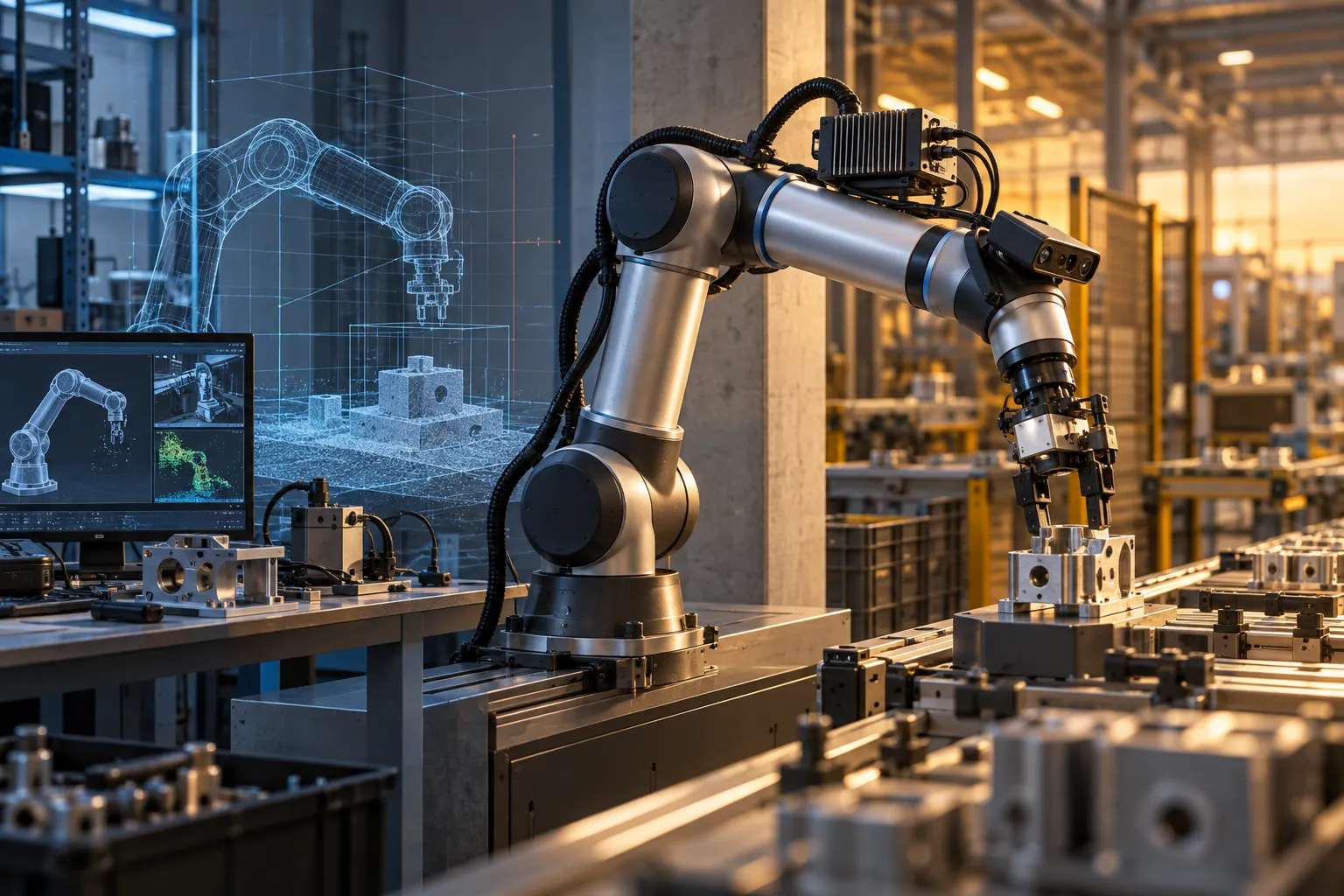
Physical AI is getting remarkably good at producing compelling demos. The harder question is what happens next.
I recently spoke with Edison Smart for the Q3 2026 edition of The Edison Edge, which looks at the people needed to turn progress in robotics, autonomous systems, edge AI, and AI-enabled hardware into viable businesses. My part of the conversation focused on the engineering side of that transition: how the technology is changing, why deployment remains difficult, and which skills will matter as more systems leave R&D and enter the physical world.
The demo is no longer the hard part
The gap between an idea and a proof of concept has compressed dramatically. Better models, open tooling, and AI-assisted development mean that work which once took months can sometimes be demonstrated in weeks.
That is real progress, but it can also distort where teams direct their attention. A convincing prototype is not yet a dependable product. Real deployments still need extensive testing, quality assurance, observability, failure recovery, and infrastructure that can support repeated operation outside a controlled environment.
Reliability and repeatability are the widest gap I see between R&D and deployment. AI can help teams improve and accelerate the work required to close it, but it cannot make the work optional. When testing and infrastructure are treated as secondary concerns or delegated too late, they become the bottleneck.
Tom Farrington captured the commercial consequence well in his contribution to the magazine: customers are not buying a demo. They are buying something that works.
World models and VLAs are converging
The technical trends I am watching most closely are world models, long-horizon reasoning, and the continued development of vision-language-action models, or VLAs.
VLAs have already absorbed ideas such as action chunking as standard components. More interestingly, world models and VLAs increasingly look complementary rather than competitive. As capabilities for modeling how an environment behaves are folded into VLA architectures, robots should become better at reasoning about the consequences of their actions over longer tasks.
Over the next five years, I expect that convergence to make VLAs far more approachable. The important shift will not just be better benchmark performance. It will be a reduction in the amount of specialized robotics knowledge required to turn an instruction into a useful, working robot job.
Deployment teams need broad engineers
The talent market is separating into two related needs. Foundation-model companies continue to need deep machine learning specialists. Deployment teams, however, increasingly need generalists who can move across software, hardware, infrastructure, and the application domain.
The closest established description is a forward-deployed engineer: someone who can understand the full system, work directly with a real operational problem, and show evidence of independent contribution. Specialist engineers remain essential, especially in machine learning, computer vision, and difficult hardware disciplines, but they make up a smaller share of an effective deployment team than they once did.
This is one reason hiring for Physical AI is difficult. Top ML and vision talent remains scarce, while hardware-oriented work frequently presents problems novel enough that conventional industry experience does not guarantee a good fit. Teams need people who can transfer knowledge across boundaries, learn quickly, and take ownership of outcomes rather than a narrow layer of the stack.
The control layer is an open opportunity
A market is forming around skills, protocols, and models tuned to particular products. Robot foundation-model companies are attracting significant funding, but the longer-term opportunity is more specific: models that understand the hardware they control well enough to close the gap between a plain-language request and a reliable robot task.
I expect robot-arm manufacturers to reach that point through partnerships and acquisitions as much as internal development. In the nearer term, there is a large opportunity for whoever creates the most robust and approachable control layer for robots. A system that makes deployment easier for people who are not roboticists would expand who can build useful automation.
LeRobot points in that direction. So would a simpler alternative to ROS designed around agentic systems from the beginning.
Turning technology into a business
The wider theme of this edition of The Edison Edge is Go-to-Market talent, and the engineering and commercial questions are closely connected. Physical AI products are complex, expensive, and deployed inside real operations. Customers need to understand not only what a system can do, but how it integrates, what return it creates, and whether they can trust it to work safely and consistently.
That requires people who can bridge technical and commercial conversations. It also means companies should think about deployment and Go-to-Market capability before a product is supposedly finished. The requirements customers care about will shape the product itself.
Physical AI does not lack impressive innovation. Its next phase depends on whether teams can make that innovation reliable, repeatable, understandable, and useful in the real world.
Thank you to Tom Farrington and the Edison Smart team for inviting me to contribute, and especially to Jessie Mackie for coordinating the feature and guiding the process from beginning to end. You can read my full five-question interview and the rest of The Edison Edge, Q3 2026.